

The recent West Bengal assembly elections received widespread coverage in Bangladesh, as did the Bharatiya Janata Party’s (BJP) historic landslide victory, which brought the party to power for the first time in the strategically important eastern border state.The BJP’s success marks the first time since 2014 — when the Narendra Modi government first assumed office at the Centre — that the political dispensation in Kolkata is ideologically aligned with the one in New Delhi. The win also comes at a time when Bangladesh, too, is under new leadership: Bangladesh Nationalist Party (BNP) chairperson Tarique Rahman became prime minister in February general elections held 18 months after public protests ended 15 years of uninterrupted rule by Awami League’s Sheikh Hasina.New Delhi-Dhaka ties plunged to unprecedented lows under the caretaker Muhammad Yunus administration, which succeeded Sheikh Hasina and oversaw the transition to the BNP government.The BJP’s rise to power in West Bengal — the state that shares the longest border with Bangladesh — is expected to shape bilateral ties significantly, at least in the near future.
Border fencing
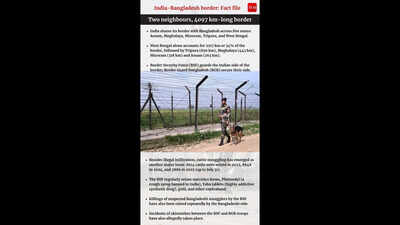
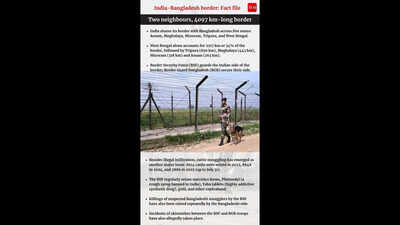
The BJP now governs three of the five states bordering Bangladesh, while one, Meghalaya, is governed by an ally (National People’s Party).Among them, West Bengal’s 2,217-km frontier alone constitutes nearly 54% of the total 4,096-km border with the neighbouring country — making the state especially vulnerable to illegal immigration attempts.For years, the BJP accused Mamata Banerjee’s Trinamool Congress (TMC) — which was voted out after 15 years in power — of protecting Bangladeshi “infiltrators” as a “vote bank” and obstructing the Border Security Force (BSF) from acquiring land needed for border fencing. In response, one of the new administration’s first decisions was to transfer land to the Union home ministry, under which the BSF operates, for fencing, with the acquisition to be completed within six weeks.The move triggered an immediate reaction from Dhaka, with Humayun Kabir, foreign affairs advisor to Prime Minister Rahman, stating that Bangladesh “isn’t afraid of barbed wire.”
“People of Bangladesh are not afraid of barbed wire… Govt of Bangladesh is also not afraid; where we need to talk, we will talk."
Humayun Kabir, foreign affairs advisor to Bangladesh PM Tarique Rahman
According to the Ministry of Home Affairs, as of August 2025, about 1,648 km (74%) of the West Bengal–Bangladesh border had been fenced. Of the remaining 569 km, 456 km was considered feasible for fencing, while the remaining 113 km was classified as non-feasible.Within the 456 km feasible stretch, the executing agency (BSF) had been handed over land for 78 km. For the remaining 378 km, the erstwhile state government had not yet initiated land acquisition for 149 km, while the remaining 229 km was still undergoing various stages of acquisition, largely due to what were described as delays by the TMC dispensation.
‘Assam model’ in West Bengal?
A picture, they say, is “worth a thousand words.” A photograph shared by Himanta Biswa Sarma following his swearing-in on May 12, marking his second consecutive term — and the BJP-led government’s third in Assam — appeared intended to convey a message.The photograph showed Sarma alongside his West Bengal counterpart, Suvendu Adhikari, accompanied by the cryptic caption: “Bad days for… (You know who).” Though the remark stopped short of naming anyone explicitly, it was widely interpreted as a reference to alleged illegal infiltrators from Bangladesh.Sarma’s administration has adopted what it describes as a policy of “pushback” to send suspected illegal immigrants back across the border into the neighbouring country. Despite criticism, he has declared that “Assam would fight and pushbacks would continue.”On April 25, Sarma announced that “20 illegal immigrants” had been sent back, the largest such number since 21 people were similarly returned on March 1. He added that “rude people don’t understand soft language” — remarks that prompted Dhaka to summon New Delhi’s acting High Commissioner to lodge a protest.
“Rude people don’t understand soft language. We continuously remind ourselves of this prophetic line when we expel infiltrators from Assam who don’t leave themselves."
Himanta Biswa Sarma, Assam CM
The public bonhomie between Sarma and Adhikari suggests that West Bengal could also consider adopting the “Assam model”. Combined with Adhikari’s past remarks on Bangladesh and the BJP’s stand on infiltrators, that possibility appears increasingly likely.
The Teesta water-sharing agreement
However, a positive outcome is expected on one front: the long-pending Teesta river water-sharing agreement.Although the treaty was close to being signed when then Prime Minister Dr Manmohan Singh visited Dhaka in September 2011, it was blocked by Mamata Banerjee, who was months into her first term as chief minister.The Trinamool supremo remained steadfast in her opposition to the pact, reiterating as recently as July 2024 that sharing Teesta’s water would deprive northern West Bengal of drinking water and irrigation needs.Congratulating the BJP, Bangladesh’s ruling BNP described Banerjee as an “impediment” to an agreement, with its senior leader Azizul Bari Helal stating that both the Modi government and Dhaka “desired the agreement.”
“Previously, we saw that Mamata Banerjee was actually the impediment to establishing the Teesta Barrage. Now, in my opinion, the Teesta Barrage agreement (would) be helped by Suvendu."
Azizul Baree Helal, BNP leader
The Teesta dispute centres on the river that originates in the Himalayas, flows through Sikkim and West Bengal in India, and then enters Bangladesh via the Rangpur division before merging with the Jamuna river. The Teesta is approximately 414 km long, with about 305 km in India and the remaining 109 km in Bangladesh.An ad hoc agreement was signed in July 1983, intended to remain in force until the end of 1985. Under the arrangement, India was to receive 39% of the Teesta’s waters, Bangladesh 36%, while the remaining 25% was left unallocated.A new treaty nearly passed in 2011 but Banerjee’s government in West Bengal blocked it.
India’s outreach to Bangladesh
The BJP’s victory in West Bengal came days after the appointment of former Union minister Dinesh Trivedi, who has close roots in the state, as India’s next high commissioner to Bangladesh. The move marked a rarity — the appointment of a politician rather than a career diplomat to an ambassadorial role — signalling New Delhi’s intent to reset ties with Dhaka through political engagement rather than routine diplomacy.In an article for The Times of India, Constantino Xavier, a senior fellow at the Centre for Social and Economic Progress (CSEP), New Delhi, described Trivedi’s appointment as India’s “signal of clear commitment” to repairing bilateral ties.
“Dinesh Trivedi’s appointment signals a clear commitment to repairing relations with Bangladesh, and giving the state (West Bengal) a greater role through para-diplomacy."
Constantino Xavier, Senior Fellow, CSEP
“After vetoing the Teesta river deal in 2011, it became increasingly clear to New Delhi that CM Mamata Banerjee was not willing to go out of her way to engage Dhaka."
Constantino Xavier, Senior Fellow, CSEP
Sensing the inevitability of a BNP victory, New Delhi had begun reaching out to Rahman following his return in December 2025 after 17 years in the UK. After the demise of Rahman’s mother, former Prime Minister Khaleda Zia, external affairs minister S Jaishankar attended her funeral in Dhaka and also delivered a condolence letter from Prime Minister Narendra Modi to the bereaved family.In February, Lok Sabha Speaker Om Birla and foreign secretary Vikram Misri attended Rahman’s swearing-in ceremony, underlining India’s intention of continued engagement with Bangladesh’s new leadership.Yet, the decisions of the BJP administration in Kolkata are expected to be crucial going forward.
The way forward
The BJP’s much-touted “double-engine” model has finally reached West Bengal. As per the party’s own political theory, this would pave the way for closer coordination between the Centre and the state — in West Bengal’s case, particularly on matters related to Bangladesh.Having made illegal infiltration a central political issue in both West Bengal and Assam, the BJP will now have to strike a careful balance between fulfilling its electoral promises on border security and immigration, and ensuring that its actions do not further strain India’s already fragile ties with Bangladesh— particularly at a time when both sides are attempting to rebuild trust and move past the bitterness of the recent past.The BJP may have made history on May 4, when vote counting took place in West Bengal, but the real test for the Adhikari government lies ahead.