



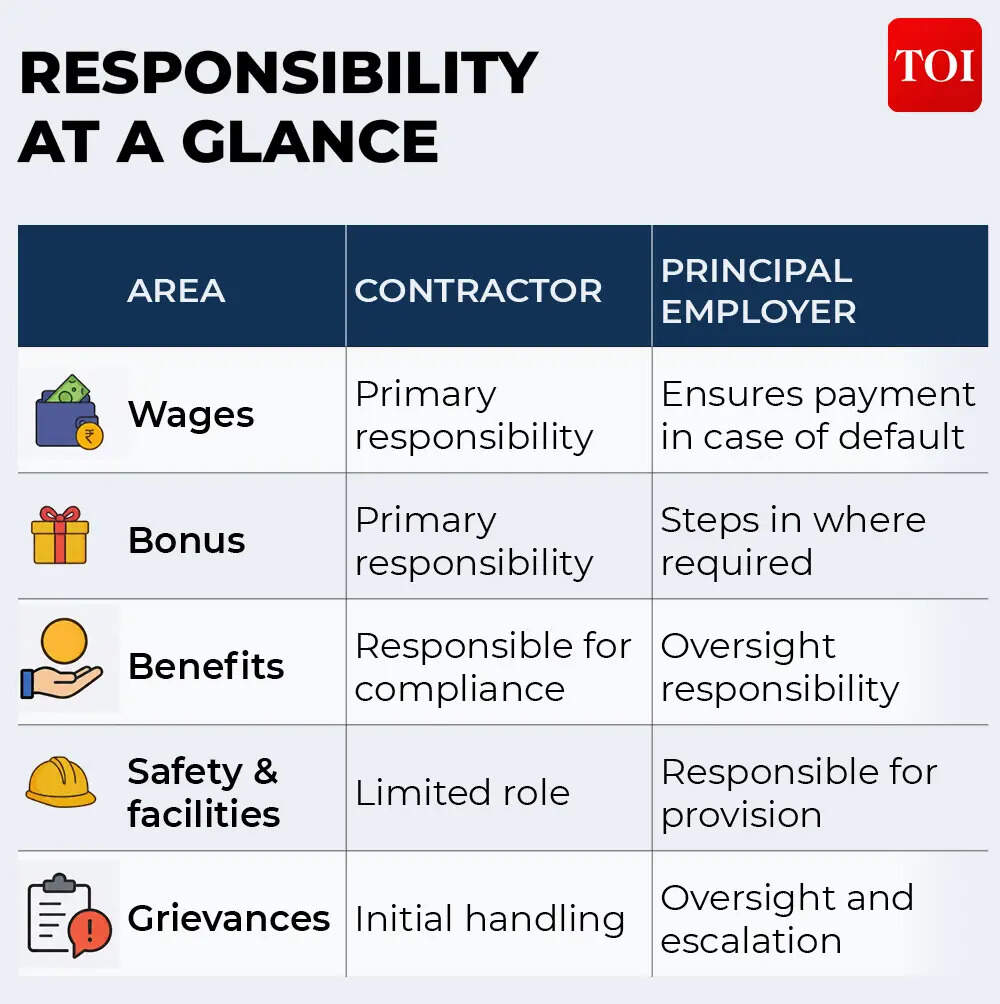
India’s labour market has long relied on people who work through contractors – across factories, offices, logistics hubs, and service roles. Over the years, the legal framework governing contract labour has provided a strong foundation for regulating such arrangements and protecting workers’ interests. The new labour codes build on this framework with a renewed focus on clarity, consistency, and ease of implementation, while continuing to support safeguards around wages, benefits, and working conditions.One important change is that the earlier Contract Labour law has now been subsumed into the Occupational Safety, Health and Working Conditions Code, 2020. While this may appear technical, the broader objective is simple – to provide a more integrated and streamlined framework for how contract workers are engaged and protected.Another notable feature under the labour codes is the way responsibilities are more clearly outlined between the contractor and the company where the work is carried out, that is, the principal employer. While contractors continue to play a primary role in managing employment, the framework sets out defined responsibilities for the principal employer as well, particularly in relation to wages, benefits, and working conditions. This clarity supports better oversight and helps ensure that statutory protections reach workers in a more structured manner.
Who is a contract labour? Simple way to understand
At its core, the law defines a contract labour as someone who is hired through a contractor to work in connection with the business of an establishment. This includes situations where a worker may not even directly interact with the principal company during hiring.For example, a housekeeping staff member working in a corporate office through an agency, or a warehouse assistant working through a manpower supplier, would generally be considered contract labour. The law also recognises inter-state migrant workers as part of this category, which is important given how many workers travel for employment.However, the law also draws a clear line. If someone is permanently employed by the contractor, receives regular increments, and has structured benefits, they may not be treated as contract labour. This distinction helps ensure that workers are classified appropriately and receive the relevant protections.From a worker’s perspective, this clarity is useful. It helps you understand which framework applies to you and where you can seek support if needed.
Where contract labour can and cannot be used
One of the important features under the labour codes is the approach to the use of contract labour in “core activities” of a business. Core activities are essentially the main functions for which a business exists.For instance, in a manufacturing unit, production work is usually core. In a hospital, medical services are core. The law provides that companies should generally avoid engaging contract workers for such core work, with certain exceptions built in.At the same time, the law recognises practical business needs. There are situations where contract labour can be engaged even in core activities. For example, where the normal functioning of the establishment is such that the activity is ordinarily carried out through contractors, or where there is a sudden increase in demand – such as a factory receiving large orders during the festive season – temporary engagement through contractors may be used.The law also provides clarity on roles that are not treated as core activities. These include support functions like cleaning, security, canteen services, maintenance, and transportation. So, if you are working in these areas through a contractor, it is considered a normal and permitted arrangement.For workers, the practical takeaway is that the law brings greater clarity on where contract roles are typically used and how such arrangements are structured.
Ensuring timely pay and financial protection
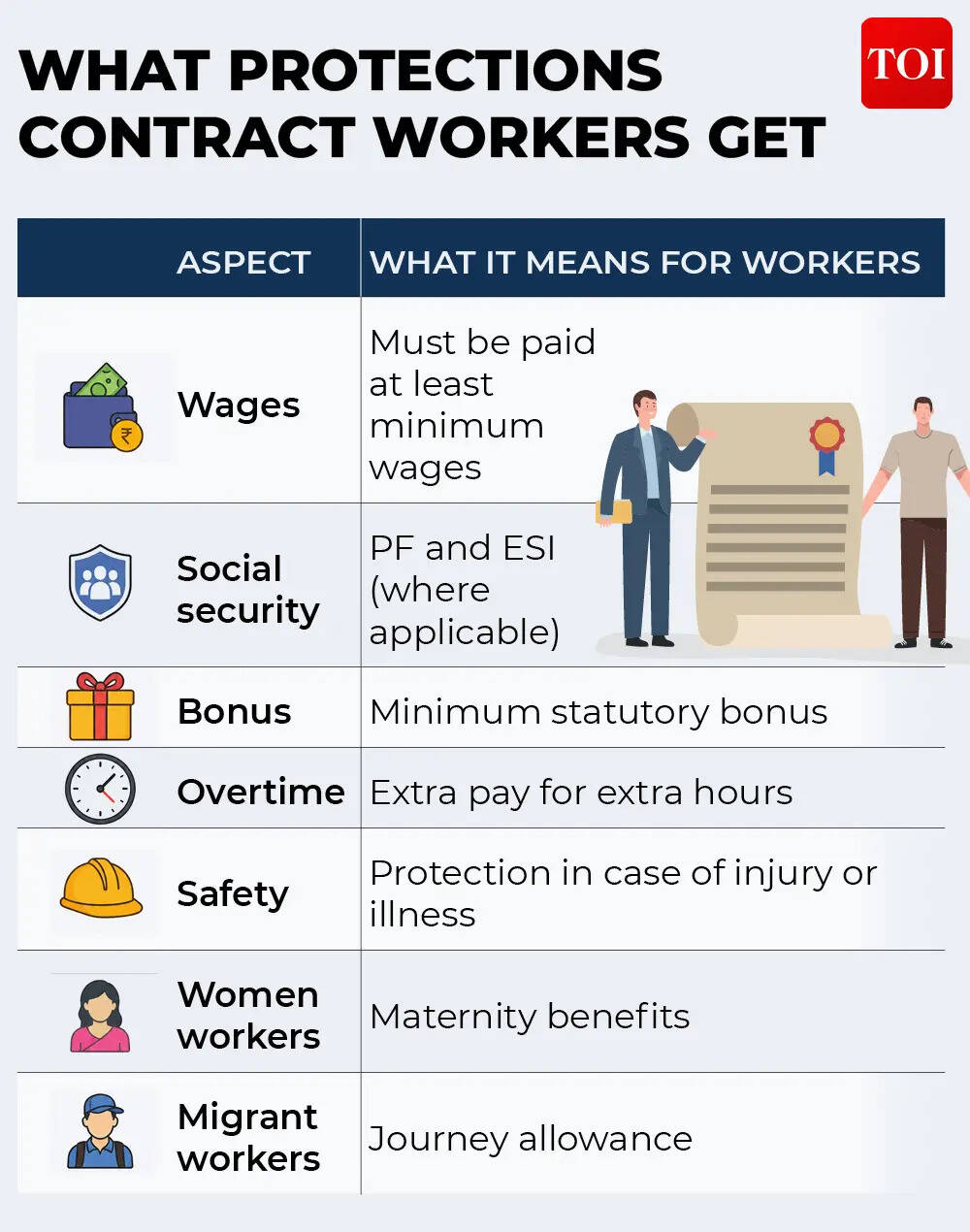
An important aspect of the labour codes is the focus on timely payment of wages and financial protections. While contractors remain responsible for paying workers, the principal employer is also required to ensure that statutory payments are made.This means that if a contractor delays payment or makes short payment, the company where the work is being done must step in and make the payment. The company may later recover the amount from the contractor, but the worker does not have to wait indefinitely.For example, imagine a worker deployed through a contractor at a logistics company who does not receive salary on time due to issues at the contractor’s end. Under the labour codes, the worker can approach the company, which is required to ensure payment. This creates an important layer of financial assurance.Apart from wages, workers are also entitled to benefits such as provident fund contributions, employee state insurance, minimum bonus, overtime payments, and compensation in case of injury. Women workers are covered for maternity-related benefits, and migrant workers may receive journey allowances.
Fair treatment at the workplace
Another important principle under the labour codes is fairness in working conditions. If a contract worker is doing the same or similar work as a directly employed worker, then the working environment should broadly reflect similar standards.For example, if two workers are working on the same production line – one directly hired and the other through a contractor – their working hours, holidays, and general conditions should be similar. This supports consistency and helps maintain workplace balance.The law looks at the nature of the work rather than just job titles. So, if the effort, skill, and responsibility are broadly similar, similar conditions are expected.For workers, this means that the mode of hiring should not result in significantly different working conditions when the work itself is comparable.
A safety net for wages and bonus
The labour codes also address payments beyond wages, such as bonus. If a contractor does not pay the minimum statutory bonus, the worker can raise this issue, and the principal employer may be required to step in after verification.This is useful in practical situations where workers may find it difficult to follow up with contractors. With the principal employer also having defined responsibilities, there is an added layer of assurance.
Raising concerns is now easier
The labour codes provide for a more structured grievance redressal mechanism for contract workers. Workers can raise concerns related to wages, working conditions, or safety at the level of the establishment where they are working.A committee may be set up to look into such concerns and resolve them within a reasonable time. If the issue remains unresolved, it can be escalated further.For example, if a worker faces unsafe working conditions or repeated delays in wages, there is now a clearer process to raise the concern and seek resolution.This helps workers have a more formal and accessible channel to address workplace issues.
Better health, safety and welfare facilities
The labour codes state that contract workers are entitled to basic health and safety standards at the workplace. This includes access to clean drinking water, proper sanitation, adequate lighting, and safe working conditions.In addition, welfare facilities such as washing areas, locker rooms, and canteen services must be provided where applicable. Where contract workers are working at the premises of the principal employer, it is the employer’s responsibility to ensure that such facilities are available.This helps ensure that all workers at a workplace have access to essential facilities.
Other practical safeguards for workers
The labour codes also include additional safeguards that support transparency. Contractors are not permitted to charge any fee or commission from workers, which helps prevent unnecessary financial burden at the time of employment.Wages are required to be paid through bank transfer or electronic mode, which improves traceability. Workers can also request an experience certificate, which may be useful for future employment.These measures support more formal and transparent employment practices.
What workers should remember
For contract workers, the labour codes provide clearer structures around responsibilities and protections. The involvement of both the contractor and the principal employer helps ensure that payments and benefits are delivered more consistently.Workers performing similar roles can expect broadly similar working conditions, and access to basic facilities is part of defined workplace standards. The availability of a grievance mechanism also ensures that concerns can be raised through a formal channel.Understanding these aspects helps workers be more aware of their rights and how to seek resolution where needed.
Conclusion: Moving towards a more structured framework
The labour codes aim to bring together flexibility for businesses and clarity for workers. For contract labour, this translates into more clearly defined protections, responsibilities, and processes.While the practical impact will evolve over time, the overall framework supports formalisation, consistency, and better understanding of roles and responsibilities.For workers, the takeaway is simple – stay informed, understand your rights, and make use of the available mechanisms where required. Greater awareness will continue to play an important role in ensuring that these protections are effectively realised in practice.(The author, Puneet Gupta is Partner, People Advisory Services Tax at EY India)