



There are exits, and then there are the kind that look as though they were engineered by a founder who has spent his career thinking in second-order effects, and the departure of Kunal Shah from the chief executive’s chair at CRED belongs firmly to the latter category.Shah is leaving the operating helm of CRED to run WhatsApp globally, a move that comes as Meta invests roughly $900 million in the company for a stake of about 20%, valuing CRED at $4.5 billion post-money. The announcement was made by Mark Zuckerberg himself, who confirmed that Will Cathcart, who has led WhatsApp for seven years and helped carry it to more than three billion users, will step aside for a new product role within Meta, while Miten Sampat takes over as interim chief executive at CRED. Kunal Shah, for his part, retains his shareholding, vacates the operating chair, and, having described Meta as a minority investor with, in his own words, “no access to member data, walks into one of the most consequential consumer-product roles in the world. It is, even by the generous standards of any startup economy, an exquisite plot twist.
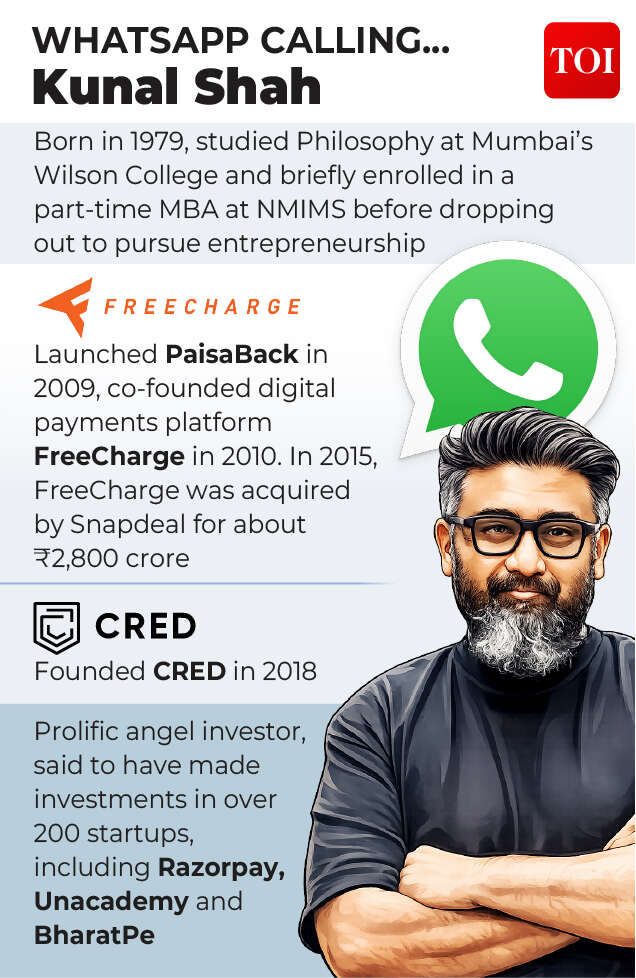
Who is Kunal Shah?
CRED’s Business Model For years the standing joke about CRED was that nobody could quite explain the business, only that the app looked expensive, the advertising was better than several streaming shows, and India’s most creditworthy citizens were being gently hypnotised into paying their bills on time. The joke was never entirely fair, for CRED began in 2018 as a credit-card bill-payment platform aimed at affluent users and has since broadened into payments, lending, card management and a widening suite of financial products.It is worth pausing on what that business actually was, because the punchline obscured a genuinely contrarian design. While most consumer startups chased mass adoption and acquire tens of millions of users first, locate a revenue model later, Shah did almost the opposite, building a deliberately gated platform open only to those with a credit score above 750, on the wager that the top sliver of Indian consumers, who account for a disproportionate share of the country’s card spending, were worth far more than a larger and poorer crowd. The product the user saw was disarmingly simple: pay your credit-card bill through CRED, on time, and collect coins, perks and access to a curated catalogue of premium brands. The machinery behind that simplicity was where the money lived. CRED earned by taking a cut of transactions routed through CRED Pay, by lending both through its own credit products and through CRED Mint, a peer-to-peer arrangement that let members put idle money to work against other vetted members and, most lucratively, by functioning as a performance-marketing channel, a kind of Google Ads for the affluent, in which brands paid handsomely for the privilege of reaching an audience that was both rich and, by construction, financially disciplined.
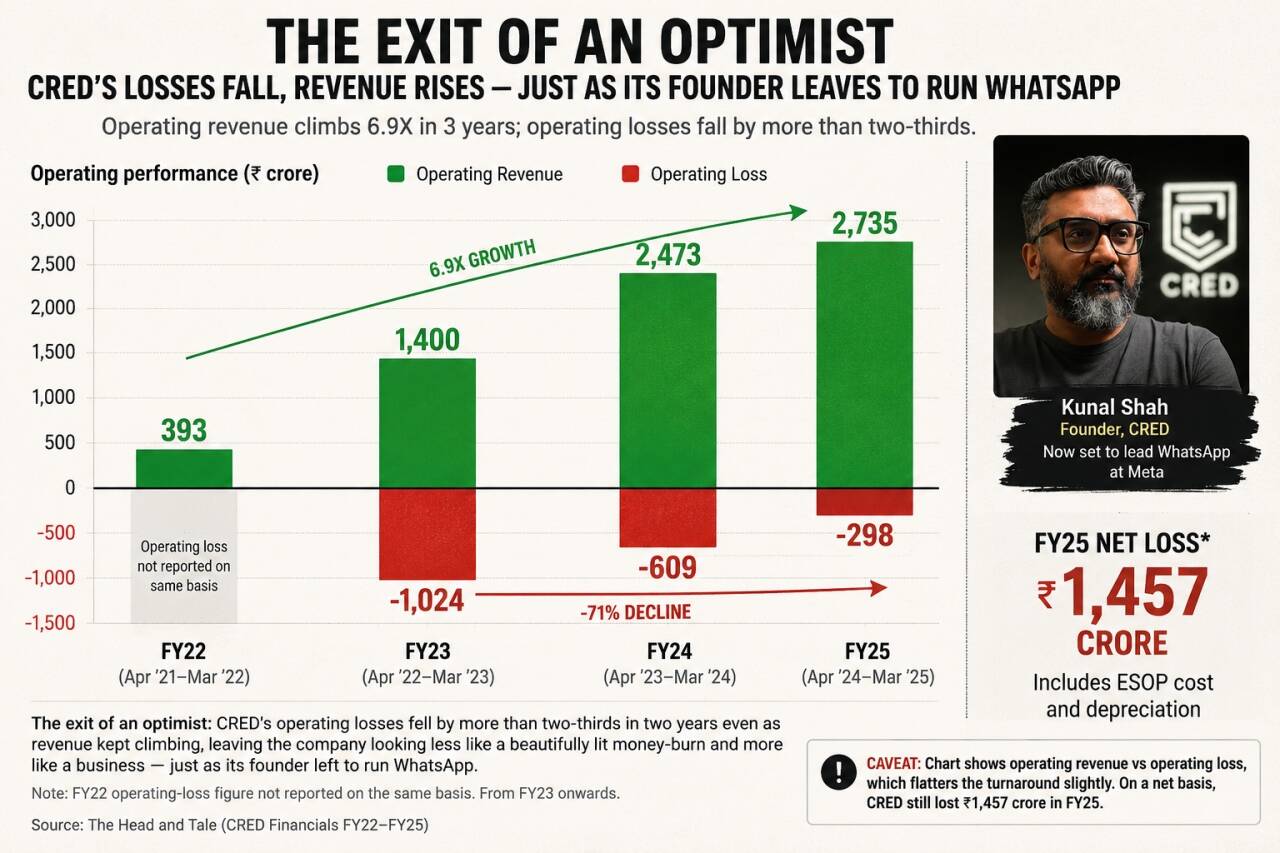
The exit of an optimist
The gamble was never that any one of these streams would be enormous on its own, but that the gated, high-trust community would compound: high-value users, the theory went, generate higher lifetime value, churn less, and become steadily more monetisable as lending, commerce and wealth products are layered onto the same relationship. Whether the arithmetic ever truly closed remained the central argument about CRED, since the rewards, the cinematic advertising and the relentless engagement engineering were expensive, and for years critics asked the uncomfortable question of whether dopamine and brand love could be converted into durable profit, or whether CRED was a beautifully lit money-burning machine waiting for the capital to run out.Kunal Shah’s OS The deeper pattern in Shah’s career, however, has never really been about CRED; it has been about behaviour. FreeCharge was a behavioural product before fintech became a costume party, and CRED was a behavioural product dressed as a financial app. It was, in a sense, an instrument, fundamentally for engineering habit and status rather than for managing money. His Delta 4 theory, reduced to its essentials, holds that products succeed when they offer an improvement over the old way of doing things large enough to make returning to it feel absurd, and WhatsApp, inconveniently for Meta, is already such a product. In much of the world, and particularly in India, it has long since ceased to be an app and become something closer to plumbing, the medium through which families quarrel, small businesses sell, residents’ associations collapse into acrimony, schools issue homework, and uncles forward democracy-threatening PDFs.This is precisely why Kunal Shah is an interesting choice, because WhatsApp does not need a leader to teach people how to send a message; it needs one who understands how trust, status, habit, and small transactions mutate inside closed networks, which is, almost exactly, the discipline CRED was built to practise.
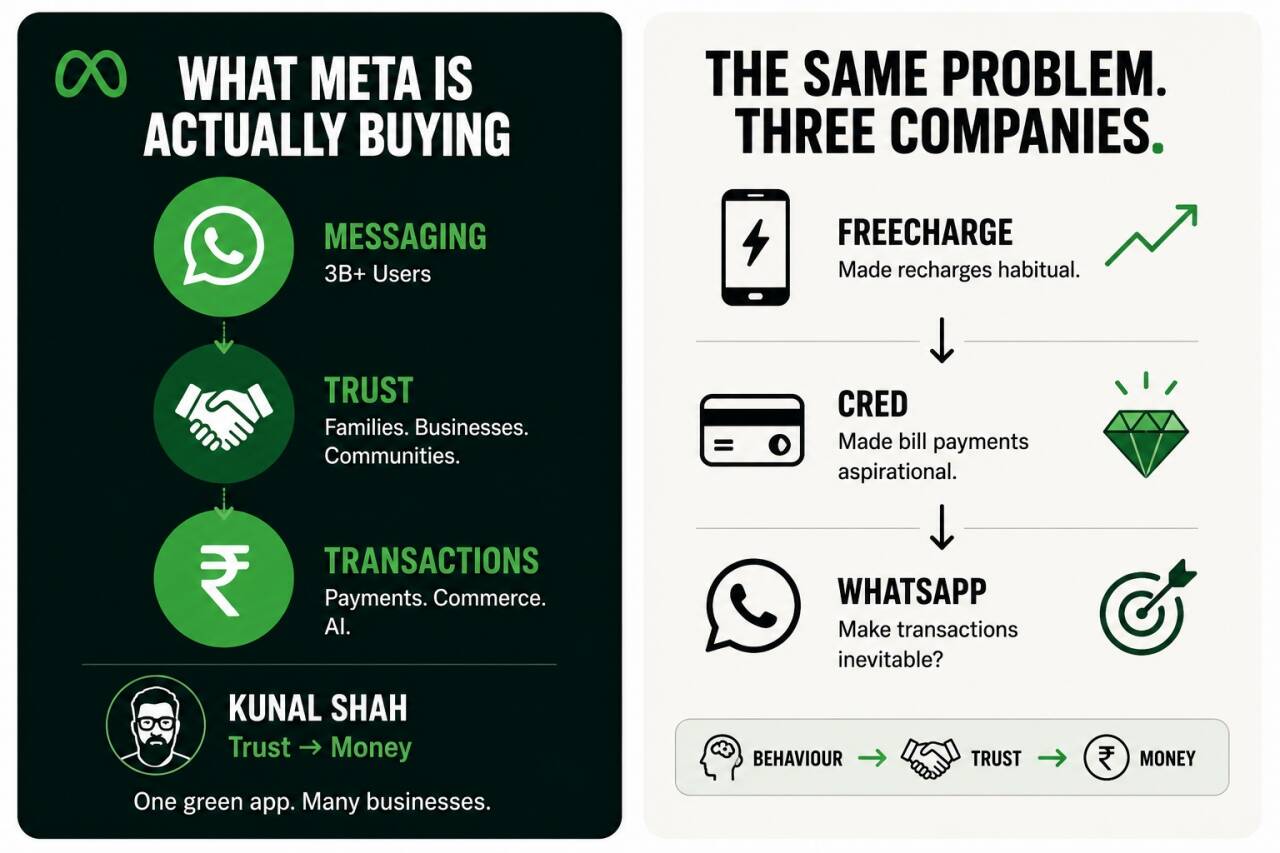
What Meta is actually buying
India is already WhatsApp’s laboratory at a planetary scale, and although WhatsApp Pay has long carried promise, it has never carried inevitability. CRED was built on a narrower but sharper version of the same problem: that the financially disciplined Indian wants reward, recognition, and convenience, and wants, while receiving all three, to feel just slightly superior for having earned them. The harder lesson Kunal Shah carries over is the one CRED never fully resolved. Engineering engagement is one thing and extracting durable revenue from it is quite another and it is exactly the lesson WhatsApp Pay has been waiting a decade to learn.The risk, of course, is that WhatsApp is not CRED, and cannot be run as though it were. CRED could afford theatricality where WhatsApp cannot; CRED was a club, whereas WhatsApp is the street. A badly designed experiment on CRED merely irritates a niche of premium cardholders, but the same experiment on WhatsApp irritates entire nations, and Shah’s central challenge will therefore be to monetise the platform without making it feel monetised, to introduce commerce without frightening regulators or users, and above all without unsettling that most sacred of Indian institutions, the family group.The premium-audience playbook that worked at CRED also runs in reverse here: CRED’s whole proposition was exclusivity, while WhatsApp’s is ubiquity, and the instincts that built a profitable club do not automatically scale to a platform whose entire value is that everyone is already on it.
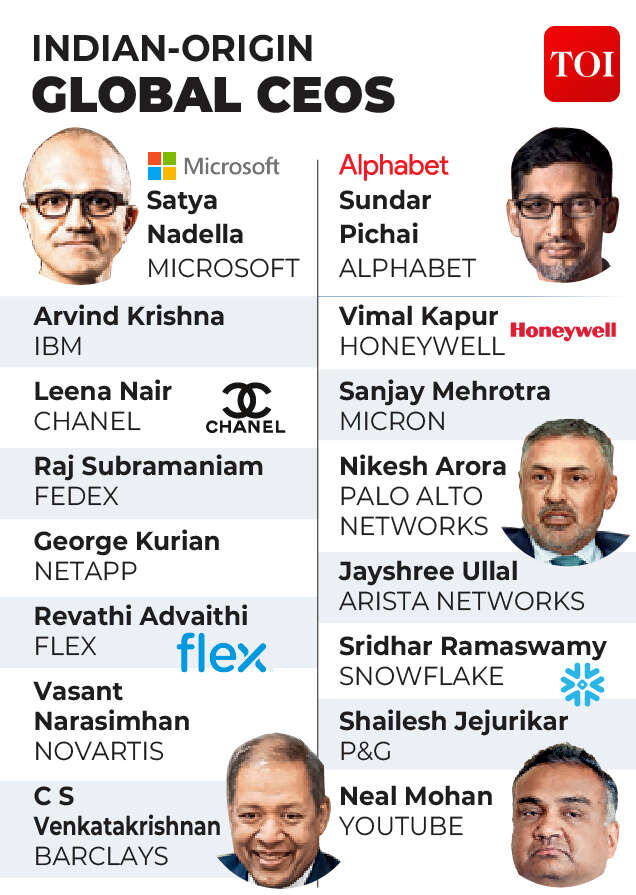
Indian-Origin Global CEOs: Check List
Meta’s Big Plans for India Meta’s interest is easy enough to read. India is not merely a market for the company but the place where its future consumer stack is most clearly visible, the arena in which messaging, payments, small business, artificial-intelligence agents, discovery, commerce, and creator-led selling are all colliding inside a single green icon. Kunal Shah has spent his entire career studying that collision between aspiration and transaction, and the assurance that Meta will have “no access to member data” does quiet but important work, allowing the company to acquire the insight without being seen to acquire the users – a distinction that matters all the more given how much of CRED’s own value always rested on what it knew about how India’s wealthiest spend.What This Means for CRED For CRED, the timing is at once a validation and a mild embarrassment. Its FY25 accounts showed operating revenue rising 16% to ₹2,735 crore, total losses narrowing to ₹1,457 crore, and operating losses falling sharply. The company secured the Reserve Bank of India’s final authorisation to operate as a payment aggregator earlier this year, permitting it to onboard merchants and to handle settlements and refunds. In other words, just as CRED was beginning to look less like a beautifully lit mystery and more like a financial-services company with genuine regulatory rails—the very thing its critics had always demanded—its founder chose to leave the cockpit.That is not necessarily a loss, for founders are useful chiefly for myth-making while operators are useful for compounding, and Shah appears to have found the one canvas larger than the company he built: not a premium application for India’s credit elite, but the transactional layer of the world’s largest messaging network.The poetry of it is hard to miss. For years, CRED asked India’s upper-middle class to prove that it was creditworthy, and Meta has now extended Kunal Shah precisely the same courtesy. Message seen. Reputation delivered.