

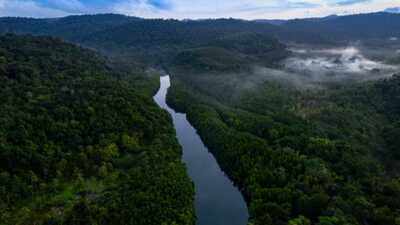
Tropical forests that are known to be the lungs of our planet face another challenge as global warming forces them out of their climatic comfort zones. According to the study published in the Proceedings of the National Academy of Sciences (PNAS), millions of hectares of tropical forests experience temperatures that interfere with the process of photosynthesis that enables trees to grow and take in carbon dioxide. According to Down To Earth, millions of hectares of tropical forests have already passed critical heat thresholds due to the work conducted by scientists at the École Polytechnique Fédérale de Lausanne (EPFL). Let us list seven interesting points about the study mentioned above.
Trees have reached their heat limits
Trees, just like people, cannot tolerate extreme heat. Researchers clarify that plants cannot effectively use the process of photosynthesis outside the certain range of temperatures. With leaf temperature reaching a critical point, the proteins involved in photosynthesis degrade. In result, trees produce less energy, grow slower and become more susceptible to diseases and even dying. The exposure to such heat leads to weakening of forest ecosystems.
Millions of hectares have already become affected
Thanks to satellite observation of temperatures collected between 2001 and 2020 along with thermal tolerance information for about 200 species of tropical plants, researchers were able to detect a dangerous tendency. The area of tropical forests experiencing canopy temperatures above the average critical threshold rose from 43 million hectares to 57 million hectares. It equals to the territory of France.
Photosynthesis has slowed down
Photosynthesis helps trees convert the energy of the sun into energy of themselves while taking in carbon dioxide and giving off oxygen. However, once the temperature exceeds the threshold, this process becomes inefficient. The study found out that excessive heat directly reduces the efficiency of capturing carbon from the atmosphere by trees.
Global warming could make the situation worse
Researchers warn that if the situation continues developing this way, the number of areas suffering from heat stress may grow very quickly. The projections made by scientists claim that by 2050, the number of hectares where the temperatures exceed the critical threshold will increase to 93 million, and by 2100 to 160 million, which is almost equal to the territory of South Africa.
Biodiversity might become affected too
Heat stress does not only influence trees. Some plant species may die because of rising temperatures, making forests lose them and having more heat-tolerant plants prevailing there. Such a situation can lead to changing of the structure of the ecosystem since countless birds, mammals, insects, and other animals depend on certain tree species for their existence.
Carbon sink of the world is losing its efficiency
Tropical forests are one of the largest natural carbon sinks of the world that absorb huge quantities of carbon dioxide annually. With decreasing efficiency of photosynthesis, the quantity of carbon dioxide taken in by the forests will become smaller, leading to more greenhouse gases remaining in the atmosphere. Scientists mention that forests can start releasing less water vapour in result of extreme heat, which might increase the chance of droughts and other extreme weather phenomena in other parts of the world.
Some forest species might be adapted to warmth
However, scientists do believe that there is still a possibility of adaptation of some forest species to warming. Gradually, heat-tolerant trees can replace those that have become less resistant to heat, which will allow forests to survive in changing climate. However, researchers warn that it is still unknown whether the natural adaptation of forests to warming happens fast enough to keep up with the acceleration of the climate change. Identification of the riskiest territories might help preservation of such valuable ecosystems.