

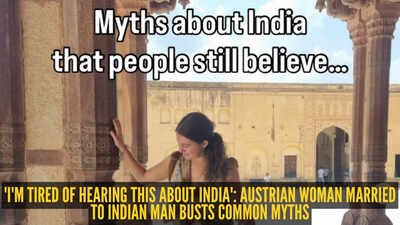
India can be a difficult country to describe in a few words. It’s too big, too varied and too full of contradictions for a single picture to ever tell the whole story.And yet, people who have never visited often have a ready-made idea of what the country is supposed to be like.An Austrian content creator married to an Indian man has now taken on some of those stereotypes, sharing her own experiences of travelling through India and questioning the assumptions she says many people still have about the country.In a social media post, Katrin spoke about everything from cleanliness and pollution to food, safety, weather and the sheer diversity of India. Her message wasn’t that the country has no problems. Rather, she argued that the problems people often associate with India are only one part of a much bigger picture.She began by acknowledging an issue that is hard to ignore.“Yes, India has problems with cleanliness in some places, and that should not be ignored,” she wrote.But, she added, that isn’t the complete story.According to Katrin, every country has areas affected by waste and pollution, but India is also home to vast stretches of natural beauty that often don’t make it into conversations about the country.She pointed to the mountains, rivers, villages and quieter parts of the country, where the experience can be completely different from what someone might expect after seeing only images of India’s busiest cities.And that’s one of the biggest points she wanted to make: India is not one single experience.
‘It is not just heat everywhere’
One of the stereotypes she challenged was the idea that India is simply hot all year round.For anyone familiar with India’s geography, that might sound obvious. But to someone looking at the country from the outside, the weather can sometimes be reduced to images of scorching summers and tropical heat.Katrin reminded her followers that India is home to the Himalayas and places such as Ladakh, where temperatures can drop well below freezing.“India has snow, winter, different climates, and many seasons,” she pointed out.From the cold mountains in the north to the warmer coastal regions in the south, the country’s weather can change dramatically depending on where you are.The same, she suggested, applies to the overall experience of travelling through India.A crowded city can feel overwhelming, but that doesn’t mean the entire country is loud and chaotic. “There are peaceful mountains, quiet beaches, forests, villages, and places where you can experience complete silence,” she wrote.She also shared a photo of a calm mountain stream alongside the words, “It is so noisy.”The contrast was clearly intentional.Yes, traffic can be loud. Yes, some cities are busy and chaotic. But there are also plenty of places where the only sounds you hear might be birds, flowing water or the wind.
What about the food and hygiene?
Katrin also addressed another common assumption – that finding hygienic food in India is difficult.Her take was fairly straightforward.Like anywhere else in the world, she said, travellers need to be sensible about where they choose to eat. But that doesn’t mean clean and reliable restaurants and cafés are difficult to find.“Food safety depends on where you eat – just like anywhere in the world,” she wrote.Based on her own experiences, she said she had enjoyed plenty of meals across India without any problems.It’s a point many travellers would probably recognise. India has everything from street food stalls to high-end restaurants, small cafés and family-run eateries. The experience can vary enormously depending on where you go.For Katrin, it was another example of why sweeping statements about an entire country don’t always tell the full story.
‘India is incredibly diverse’
Perhaps the biggest misconception she wanted to challenge was the idea that India can be understood as one uniform place.It can’t.The country is home to hundreds of languages, countless traditions and enormous differences in food, clothing, landscapes and lifestyles.Katrin pointed to the contrast between South India and the Himalayas, as well as the Northeast and Rajasthan.People can look different, speak completely different languages and follow traditions that have little in common with those found in another part of the country.And that, she suggested, is precisely what makes India so fascinating.For someone travelling through the country, moving from one state to another can sometimes feel like entering an entirely different world.
Her experience with people and safety
Katrin also spoke about safety, another subject that often comes up when India is discussed internationally.She acknowledged that no country is completely safe and that, like anywhere else, India has both good and bad people.But her personal experience, she said, was largely positive.She described many people she met as warm, welcoming and helpful. Some, she said, treated her like family.She also mentioned that some of her closest friendships are with Indians.At the same time, she stressed that travellers should always use common sense, regardless of where they are in the world.Her message was not that visitors should ignore potential risks. It was that safety and travel experiences cannot be reduced to a single sweeping stereotype.
Beyond the stereotypes
Katrin also touched upon poverty, acknowledging that it is a very real issue and one that she finds heartbreaking.But she argued that India’s story is far more complicated than poverty alone.The country has an enormously rich and complex history, with centuries of art, architecture, culture, science and trade shaping its identity.Her larger point seemed to be that two things can be true at the same time.India can have serious challenges that need attention, while also being a country of extraordinary beauty, diversity and cultural richness.One doesn’t cancel out the other.That appears to be the thinking behind the photo gallery she shared alongside her post. The opening image carries the title “Myths about India that people still believe,” while the pictures that follow offer a more varied look at the country she has experienced.From peaceful landscapes to quieter corners, the images push back against the idea that India’s identity can be summed up by a handful of familiar stereotypes.And perhaps that’s the real message behind her post.India isn’t perfect. It has its problems, just like every other country. But it is also far too vast and diverse to be understood through a few negative headlines or assumptions.For Katrin, who has travelled through the country and built a personal connection to it through her marriage and friendships, the reality she has experienced is much more layered.There is noise, but there is also silence.There is chaos, but there is also calm.There are crowded cities, but there are also mountains, forests, beaches and villages.And beyond everything else, there is a country that changes dramatically from one place to another – something that, in her view, is perhaps the biggest myth of all to overlook.