

Data tabled in Lok Sabha last year showed that an average of a third of drug-related cases in Gujarat have seen convictions since 2020. Now, the Gujarat Police has developed an artificial intelligence (AI)-based tool to help police make tighter cases under the Narcotics Drugs and Psychotropic Substances (NDPS) Act to ensure conviction.
Earlier this month, the Gujarat government announced the Narcotics Analysis & RAG-based Investigation Tool (NARIT-AI). The tool, designed to help law enforcement agencies in handling complex narcotics cases under the NDPS framework, will integrate legal provisions, case laws, and investigative procedures to provide real-time analytical support to investigating officers (IOs).


What led to the development of this tool and how will it help the police secure more convictions in drugs-related cases? Here’s what to know.
The AI framework
NARIT-AI was developed using Retrieval-Augmented Generation (RAG) technology. RAG is an AI framework that improves the accuracy of a large language model (LLM) by referencing trusted knowledge bases before generating responses, which in this case are laws, circulars, cases, and judgments on narcotics cases in India.
Beginning January 2026, development was completed in three months. The last month was spent on field trials on drug possession of cultivation seizure cases from across Gujarat being fed as prompts into the application to get the correct procedures and other details for IOs to follow, based on laws in force and previous judgments of the Supreme Court and various High Courts in India.
NARIT-AI was conceived by Abhay Soni, a Superintendent of Police (SP) currently posted with the Government Railway Police (Western Railway) in Vadodara. The Gujarat Police developed the tool in collaboration with Gradiante Creative Services, an AI-led executive training startup ostensibly headquartered in Seattle (US). Soni, however, said that the company is based in Mumbai with its servers located in India.
According to Soni, “the most important thing in any investigation under the NDPS Act is the ‘primacy of procedure’. If there is a lapse anywhere, even in a single step, even if you have strong or overwhelming evidence, the benefit of doubt is given to the accused. In many cases we have seen people getting easy bail and even acquittal where there should have rightfully been a conviction.”
Story continues below this ad
Given the limited number of “writers” (police staff assigned with documentation) in each district, mostly attached to special operations groups which specialise in NDPS cases, there were delays and burgeoning cases — administrative gaps that needed resolution.
Soni told The Indian Express that he was inspired by a session he attended in December 2025 on how to best use AI in policing. There, a professor from the University of Texas presented a case study on RAG’s practical use in academia. The professor, Soni said, showed a faculty audit wherein feedback from students about their teachers was fed into the RAG system to get a compiled report on each teacher, based on which administrative decisions could be taken.
How it works
Unlike other AI tools that trawl the entire internet, RAG only searches a very specific database of material fed into it to generate solutions related to the query at hand. NARIT-AI’s developers say it has been trained with data on the laws governing narcotic drugs and various judgments, and a First Information Report can simply be uploaded on it prompted with specific questions to generate responses on what to do to build the case.
“We have trained this model on this data library in a closed environment,” said Soni. “Apart from the fact that NARIT-AI looks only at current, amended laws and procedures in the Indian context, it also eliminates hallucinations. This means that it does not create or make up citations on its own but only generates answers based on pure facts on which it has been trained,” he added.
Story continues below this ad
Notably, there have been instances where AI models have not just generated false or non-existent citations for medical research and other academic papers, but also judgments that were never passed, when used in the context of law. Officials claim that during field trials conducted in March, the closed system ensured that the end results were consistent with extant laws and judgements that are in its database. They even approached the Narcotics Control Bureau to take a trial of the system.
NARIT-AI uses an enforcement-grade double layer encryption and sandbox approach, and is restricted to verified users are all security measures. Following recent Gujarat High Court guidelines on the use of AI, the application is classified as a private AI system developed specifically for Gujarat Police and not accessible to the general public.
The tool is not a static system: when the laws are amended or new circulars replace old ones, the database will also be updated and asked to read the latest documents.
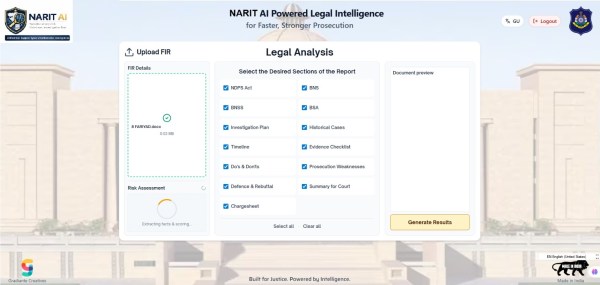
Police officials said that the system is easy to use and required just the upload of an FIR and three clicks to get a response based on the prompt generated based on the specificity of the case in question. Details of the product in development shows that the IO can choose the amount of output required based on the uploaded FIR.
Story continues below this ad
 Officials said that a tool like NARIT-AI could help them not only make investigations procedurally compliant, but also show them weaknesses in the case that could possibly be exploited by the defence team in courts.
Soni, having seen firsthand how procedural lapses could lead to acquittal even in cases of strong evidence, simply because the steps had not been followed to the letter, said that a closed system tool to help IOs with NDPS cases could help them not only make investigations procedurally compliant, but also show them weaknesses in the case that could possibly be exploited by the defence team in courts. This made NARIT-AI also act as a paralegal well before the public prosecutor even comes into the picture.
According to officials, NARIT-AI will apparently be able to provide — apart from referencing against the NDPS Act, the three criminal laws, and previous judgments — an “investigation plan”, give a “timeline” for completion, Dos and Don’ts, provide an “Evidence Checklist”, provide a draft “Chargesheet”, submit potential “Prosecution Weaknesses” and “Defence Rebuttals”, as well as a “Summary for Court”.
Soni said: “The officer will be able to see all the options selected for the particular FIR. The result will be case specific and that is possible because the litigation base is so large, that every type of case an officer may come across, may have already been in court at some point or the other.”
After a contract is signed between Gujarat Police and Gradiante, NARIT-AI will be rolled out. Officials told The Indian Express that about five teams across the same number of regions will be given access to the system, and police officials from surrounding jurisdictions could send their queries there to receive the results.
Institutional lapses
Story continues below this ad
Interestingly, the report of the Comptroller and Auditor General (CAG) of India for the financial year 2023-24, tabled in the Gujarat Assembly last month, slammed the state Home Department for neither establishing proper storage facilities for seized drugs nor disposing of drugs expeditiously as per procedures prescribed under the NDPS Act and Supreme Court orders. Citing a case where the Gujarat Police told CAG that over 114 kgs of ganja had been destroyed by rats, the audit noted that these shortfalls “highlighted weak institutional controls and lack of supervisory oversight at multiple levels”.
Moreover, in a response last July to a starred question in Lok Sabha, the Centre gave details of the number of cases and conviction rate under the NDPS Act for states and Union Territories between 2020 and 2022. In Gujarat, there were 308 cases in 2020 and the conviction rate was 44.4%. For 2021 and 2022, the number of cases were 461 and 508 whereas the conviction rates were 33.3% and 25% respectively.