

The effective halt in vessel movements through the Strait of Hormuz due to the West Asia war has hit India’s energy supplies, particularly those of liquefied petroleum gas (LPG) and liquefied natural gas (LNG). Although India’s crude oil supplies have also been hit due to the crisis, the country’s dependence on West Asian oil is relatively lower than for LPG and LNG, and barrels from alternative sources are relatively easier to secure.
LPG, particularly, has been a cause of concern, given that India depends on imports to meet around 60% of the fuel’s needs, and 90% of those imports came through the critical maritime chokepoint of the Strait.


This means that around 54% of India’s LPG supplies are effectively disrupted, forcing the government to heavily cut supplies to commercial and industrial consumers in an effort to ensure uninterrupted supplies to crores of households that use the fuel for cooking.
Some stress is also visible in the natural gas segment, where supplies to commercial and industrial consumers has been reduced to some extent to ensure supplies to priority segments like households using piped natural gas (PNG) and vehicles running on compressed natural gas (CNG). India depends on LNG imports to meet half of its natural gas requirement, and 55-60% of it comes from West Asia through the Strait of Hormuz.
This means that the strait’s effective closure has cut off roughly 30% of India’s natural gas supplies. Relative to LPG, the situation is much better, which is evident from the fact that the government has been urging LPG consumers to shift to PNG wherever feasible.
While both LPG and LNG are hydrocarbon gases turned into the liquid state, they differ in their chemistry, production processes, transportation, and delivery.
Chemistry and physics of LPG and LNG
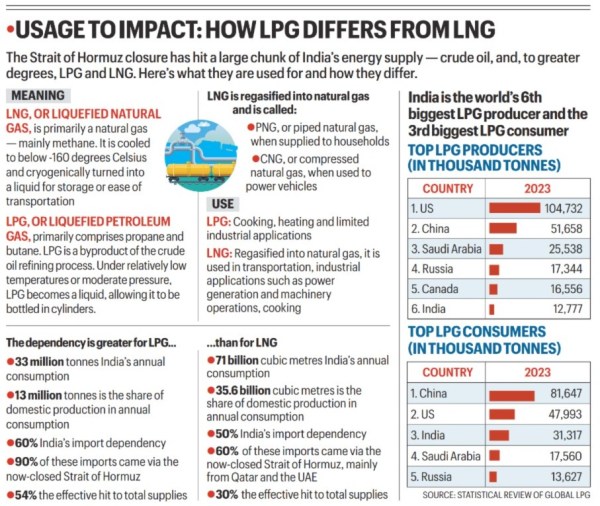
LPG is a gaseous fuel mix primarily comprising propane and butane that is a byproduct of crude oil refining and natural gas processing. It may also contain some propylene, butylene, and isobutylene or isobutene.
Story continues below this ad
Under relatively low temperatures or moderate pressure, the gas mix becomes a liquid. It is mostly used for cooking and heating, with some industrial applications as well; it is also used as an automobile fuel in some parts of the world. LPG’s volume is around 1/260th of its gaseous volume.
LNG, on the other hand, is primarily natural gas — mainly methane — cooled to below -160 degrees Celsius and cryogenically turned into a liquid. Now, LNG itself doesn’t have too many direct uses, except for an upcoming fuel to power heavy vehicles, ships, and trains. The key purpose of liquefaction of natural gas into LNG is to transport it over long distances across seas, where supplying natural gas through pipelines is not feasible.
Unlike LPG, LNG must be stored in cryogenic tanks and requires trained handling to prevent vapourisation or boil-off. In its liquid state, LNG occupies roughly 1/600th the volume of natural gas in gaseous form, making it viable for transport and storage over long distances. The problem, though, is that this has to be done cryogenically, and is energy intensive.
Essentially, LNG is natural gas that is liquefied for easier storage and transportation, and is mostly converted back to natural gas before being used. Natural gas itself has a number of applications — cooking fuel, transportation fuel, and industrial fuel or feedstock in sectors like refineries, fertilisers, power plants, and petrochemicals.
Delivery, storage, safety
Story continues below this ad
LNG is transported in specialised cryogenic ships and lands at LNG regasification terminals, where it is converted back into natural gas and then transported further, mostly using pipeline networks. The natural gas is sent to the end user usually through pipelines — sold as PNG to households and industries, and as CNG or automobile fuel sold through dispensing stations.
LPG, on the other hand, is bottled into cylinders and transported mainly by road to the end consumer. As it doesn’t really depend on pipeline connectivity, LPG becomes highly portable and can be made available in any region, even remote and rural areas that may not have any pipeline connectivity. It is also much easier to store, as it just needs pressurised cylinders.
By contrast, every household that wants to use PNG must have pipeline connectivity at doorstep, and natural gas itself cannot be really stored, unless it is liquefied. This is why LPG is now increasingly being seen as a fuel for rural and remote areas, while PNG is being encouraged in urban areas.
Although PNG requires pipeline infrastructure, once it is established, the fuel scores higher than LPG in terms of convenience for users. The pipeline provides uninterrupted supply and there is no need to store or keep track of the gas stock as in the case of LPG, where cylinders need to be booked and exchanged at regular intervals. PNG supplies are constant and metered, like power supply, and there is no need to make bookings.
Story continues below this ad
PNG is also considered safer than LPG. This is because natural gas is lighter than air, which allows it to disperse quickly in case of a leak. LPG is heavier than air, and therefore tends to sink and accumulate in the air in case of leakage, which makes it a lot more prone to fires and explosions in such instances.
Moreover, there are minimal human handling requirements of PNG from the city gas distributor’s facility to the consumer as the entire transmission is through pipelines. As for LPG, each time a cylinder runs out of gas, it has to be manually disconnected and replaced by the refill cylinder.
Amid the crisis, Govt push for PNG expansion
The government has been maintaining that the LPG supply situation is a cause of concern, even as LPG supplies to households are being maintained at regular levels. Meanwhile, priority sectors continue to receive protected natural gas supplies, including 100% supply to the household PNG and CNG for transport segments, while supplies to industrial and commercial consumers are being regulated at around 80%.
Although natural gas supplies to India have also been hit due to the Strait of Hormuz’s closure, the situation is not as concerning as in the case of LPG. The effective closure of the Strait of Hormuz has hit roughly 30% of India’s natural gas supplies, as against 54% of the country’s LPG flows. Also, in the most vulnerable segment of household consumers, India has a huge LPG consumer base with 33.3 crore domestic connections. Households with PNG connections are far fewer, at about 1.5 crore.
Story continues below this ad
Over the past few days, the government has been appealing to consumers to switch to PNG if it is available in their vicinity to take some pressure off of LPG supplies. Some City Gas Distribution (CGD) companies have also announced incentives like some volumes of free gas and waiver of connection charges to encourage consumers to sign up for PNG connections. The Centre has also urged states to help expedite PNG network expansion, and has even offered additional commercial LPG allocation if they take certain specific measures in this regard.
The Petroleum and Natural Gas Regulatory Board (PNGRB) also advised CGD companies to deploy additional resources and step up outreach to provide connections quickly to consumers wherever networks are available. According to the government’s estimates, there are roughly 60 lakh households that are in the vicinity of PNG coverage, and can quickly switch to piped gas connections.
Apart from prioritising LPG supplies to households over commercial and industrial consumers, the government ordered refiners to maximise LPG production, and directed them to divert propane, butane, and other streams from petrochemical manufacturing to LPG production. These measures have led to an increase of 40% in domestic LPG production vis-à-vis pre-West Asia conflict levels, which means that India’s own LPG production is now meeting roughly 55% of the country’s demand versus 40% earlier.
The government has also increased waiting times between cylinder bookings by households from 21 days to 25 days in urban areas and 45 days in rural areas to check hoarding behaviour and manage demand and supply. It has also activated alternative fuel streams like kerosene, fuel oil, biomass, and even coal for commercial consumers to help them cover their LPG shortfall.