

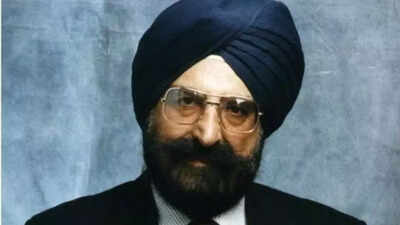
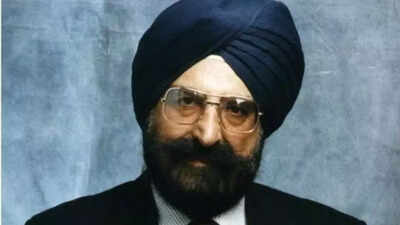
When people make a video call, stream a movie, send an email, or browse the internet, few stop to think about the technology carrying that information across continents in a fraction of a second. Even fewer know that one of the key pioneers behind this transformation was an Indian-born scientist whose work changed the course of modern communication.The pioneer who made such significant contributions is Narinder Singh Kapany, popularly known as “Father of Fiber Optics.” His pioneering discovery provided the foundation for the worldwide communication system which we today use as a source of the digital revolution.
A tale of Punjab leading to a discovery that revolutionized the world
Narinder Singh Kapany was born on October 31, 1926, in Moga, Punjab, to a set of parents whose son would later grow up to be one of the greatest scientists in history. Having been brought up in a Sikh family, Kapany studied in Dehradun before eventually graduating from Agra University. Science was the area he loved, and thus he chose to study optics.It was in the early 1950s that Kapany moved to London, where he began his studies at Imperial College London. This is when he began conducting experiments with light in glass fibers.Scientists had already attempted to transmit images through optical fibers, but the quality of the images was not satisfactory at all. It was through their experiments that the duo made it possible to transmit better-quality images through optical fibers.Though the accomplishment might have seemed technical and minor at the time, it would eventually lead to monumental consequences. The innovation developed into the modern optical communication technology, which is capable of transferring colossal data volumes from one continent to another.Besides contributing to the advancement of science, Kapany was responsible for creating a distinctive name for the field. As early as 1960, he introduced and widely used the term “fiber optics” in an article published in Scientific American magazine. Then, he went on to author the first book about fiber optics and became a major proponent of the new technology.
Beyond fiber optics: Scientist, entrepreneur and cultural patron
His scientific interests extended well beyond fiber optics. Over the course of his career, Kapany worked on lasers, biomedical instruments, solar energy, and pollution monitoring technologies. His innovative spirit led him to acquire over 120 patents that showcased his dedication to finding solutions to real-world challenges using science.In addition to being a scientist and researcher, Kapany was also an enterprising person. He started Optics Technology Inc. in 1960, which is an optics technology development firm. Besides this firm, he started some other firms as well in order to translate lab-based discoveries into business opportunities. At a time when innovation and startups were not trendy terms, Kapany had already shown how science could become a product and industry.His contributions did not confine themselves to only business enterprises; he was also instrumental in the field of academia. He worked as a teacher and mentor at the University of California, Berkeley, and the University of California, Santa Cruz. At the latter university, he founded the Center for Innovation and Entrepreneurial Development.Yet Kapany’s legacy cannot be measured only through laboratories, patents, or businesses. With strong ties to his culture, he turned out to be a great promoter of Sikh heritage. Through the Sikh Foundation, which he chaired, he worked for decades on various initiatives aimed at safeguarding Sikh heritage.His collection of Sikh art has been recognized all over the world, contributing greatly to the promotion of Sikh heritage globally through exhibitions held in cities like London, San Francisco, Toronto, and others.Despite his great contributions, Prof. Kapany was unknown to the world at large except within science-related areas for a long time. However, it is increasingly becoming known to everyone.In 1999, Fortune magazine named him among the seven “Unsung Heroes of the 20th Century” for helping shape modern life through innovation. The same year, Time magazine included him among the century’s leading scientists.India honoured him posthumously in 2021 with the Padma Vibhushan, the country’s second-highest civilian award. The recognition came months after his death on December 4, 2020, at the age of 94.Today, every high-speed internet connection, every international data transfer, and every digital communication network carries traces of the vision that Kapany helped create. His work transformed light into information and information into a force that connects billions of people around the world.In many ways, the modern digital age travels through the path he illuminated decades ago. Narinder Kapany’s story is not just the story of a scientist. It is the story of a man who looked at a beam of light and saw the future.