

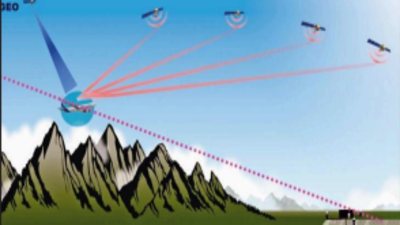
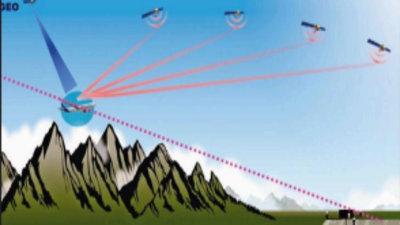
NEW DELHI: In a major safety enhancing move, the Directorate General of Civil Aviation (DGCA) Thursday got a “satellite-based landing system (SLS)” approach conducted for the first time on a jet engine aircraft in India. The regulator got the flight operated on an IndiGo Airbus A320 in Udaipur using Isro and Airport Authority of India’s satellite-based navigation system Gagan (GPS-aided geo augmented navigation). Jet engine planes have jumped on the band- wagon a few years after a turboprop ATR had done so. SLS is seen as a gamechanger in terms of enhancing safety at secondary airports that do not have expensive instrument landing system (ILS) installed, as it allows the use of new satellite navigation technologies to perform approaches. SLS first entered service in Europe with the A350 in 2015. Officials in the know say the IndiGo Airbus flight to Udaipur was “another significant milestone in advancing satellite-based navigation in India by successfully conducting a localiser performance with vertical guidance (LPV) approach.” IndiGo had introduced LPV operations on its ATR fleet in 2022 and has now expanded “satellite-based augmen- tation system” (SBAS) enabled operations across its fleet. Jointly developed by Isro and AAI, India’s SBAS Gagan provides the coverage needed for LPV procedures across Indian airspace and positions India as one of the few countries worldwide with its own SBAS capability. As more airports adopt LPV procedures and more air- lines equip their aircraft with SBAS capability, Gagan is expected to play a central role in the future of Indian aviation by making air travel safer, more efficient and accessible. “For decades, aircraft have relied on ground-based navigation systems to guide pilots safely to the runway, especially during poor weather or low visibility. SBAS… enhances accuracy, integrity, and availability of standard GNSS signals by broadcasting correction data from geostationary satellites. Instead of depending solely on equipment installed at airports, SBAS allows pilots to receive precise horizontal and vertical guidance while approaching the runway, even at airports that do not have conventional precision landing sy- stems...,” said a senior pilot.