

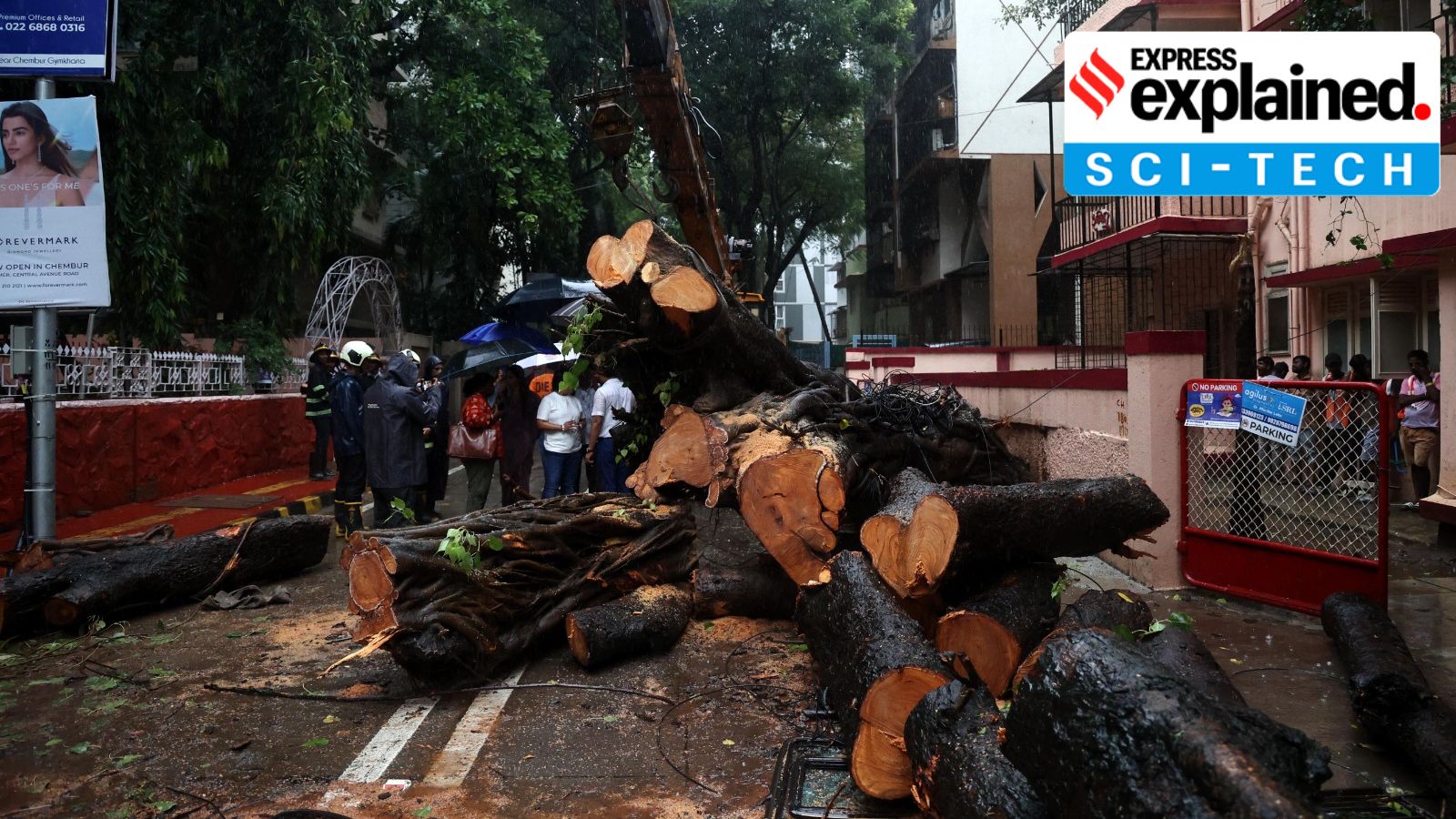
Between July 1 and July 5, Mumbai reported 559 tree-fall incidents, including 203 cases in the last 24 hours alone. In less than a week, three people—including an 11-year-old boy—lost their lives, while several others were injured in multiple tree-fall incidents across the city.
While tree collapses are a recurring feature of the monsoon season, this year’s surge has been unprecedented, raising serious concerns over public safety.
According to the Brihanmumbai Municipal Corporation’s (BMC) data, 687 tree-fall incidents were reported in 2023, 653 in 2024 and 855 in 2025.
The spike in such incidents has also put the spotlight on the BMC’s ambitious ₹17,000-crore road concreting project. Notably, two of the three fatal tree-collapse incidents occurred along roads that had recently been concretised, prompting fresh questions over whether the project may have compromised the stability of roadside trees.
Mumbai and its trees
According to the BMC’s 2011 tree census, Mumbai had nearly 29.75 lakh trees. However, the actual number is likely to be lower today, as a significant portion of the city’s green cover has been lost over the past decade to infrastructure projects. Repeated tree collapses during successive monsoons have also contributed to the decline.
Besides parks and open spaces, a large number of trees line Mumbai’s roads. Most are indigenous species such as neem, peepal, banyan and gulmohar. Many of these mature trees grow over 20 metres tall and have expansive canopies that provide much-needed shade and ecological benefits.
These roadside trees are planted in square-shaped soil pits, commonly known as tree basins. However, experts have long criticised the maintenance of these basins, pointing out that many have been encroached upon by cement and concrete during road widening, road concretisation, utility trenching, fibre-optic cable laying and stormwater drain projects.
Story continues below this ad
Tree roots require loose, aerated soil to anchor themselves firmly. When concrete is laid around the base of a tree, it restricts root growth and damages the root zone. Over time, the roots lose their ability to spread, absorb water and oxygen, and securely anchor the tree. As the foundation weakens, trees become increasingly vulnerable to uprooting during heavy rainfall or strong winds.
The ongoing road concretisation project has further intensified these concerns. In several parts of the city, tree basins have been partially or completely covered with concrete. This prevents rainwater from percolating into the soil and restricts the flow of oxygen to the roots. As the roots gradually weaken and decay, the tree’s structural stability is compromised, increasing the likelihood of collapse during the monsoon.
The high-wind factor
On Sunday, when Mumbai recorded 203 tree-fall incidents in a single day, wind speeds reached 75-79 kmph, according to the India Meteorological Department (IMD).
Mature trees are extremely heavy, with their large canopies acting like sails during high winds. When their root systems have already been weakened by soil saturation or construction activity, they are unable to withstand the lateral force exerted by strong gusts. As a result, trees can be uprooted or toppled onto roads, vehicles and pedestrians.
Story continues below this ad
According to IMD data, Mumbai typically experiences wind speeds of around 20-30 kmph during the monsoon, which may rise to about 50 kmph during periods of heavy rainfall. Wind speeds approaching 80 kmph, however, place enormous stress on trees, particularly those with compromised root systems.
What do the rules say?
In 2013, the National Green Tribunal (NGT) directed that a one-metre buffer zone be maintained around the base of every tree to ensure adequate space for root growth and rainwater percolation. Subsequently, the BMC issued mandatory guidelines requiring adequate safeguards for trees during road concretisation, excavation, trenching, drainage works and other infrastructure projects.
In 2019, the Union Ministry of Environment, Forest and Climate Change also directed urban local bodies to maintain an unconcretised 6-metre by 6-metre area around trees in public spaces to facilitate water percolation and healthy root development.
However, BMC officials admitted that these norms are frequently violated in Mumbai, with concrete often being laid right up to the tree trunk. This damages the root system, restricts aeration and water absorption, and eventually weakens the tree’s structural stability.
Story continues below this ad
Civic officials told The Indian Express that many contractors engaged in the ongoing road concretisation project lack adequate understanding of how tree basins should be protected during excavation. They added that the BMC’s Tree Authority is often not consulted before road-digging work begins, increasing the risk of irreversible damage to roadside trees.