

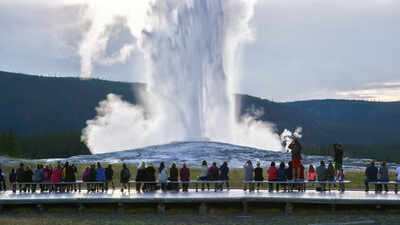
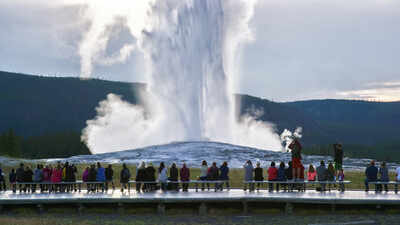
Some places become famous because of what people build there. Yellowstone became famous because of what nature built beneath its surface.In the summer of 1870, a group of explorers stood in what is now Yellowstone National Park and watched a towering column of boiling water shoot into the sky. Then they waited. About an hour later, it happened again. And again. The eruptions were so regular that the explorers felt they were watching a natural clock. They named it Old Faithful, a title that captured exactly what they had witnessed.More than 150 years later, Old Faithful continues to erupt almost every day, drawing millions of visitors from around the world. It is not just Yellowstone’s most famous attraction. It has also become one of the best-known examples of Earth’s incredible geothermal power.
What exactly is a geyser, and why are they so rare?
A geyser is much more than a hot spring. It is one of the rarest geological features on Earth.According to the US Geological Survey (USGS), fewer than a thousand active geysers exist worldwide, and more than half of them are found inside Yellowstone National Park. That alone makes Yellowstone unlike almost anywhere else on the planet.A geyser needs an unusually perfect combination of natural conditions.First, there must be a powerful underground heat source. In Yellowstone, that heat comes from a massive volcanic system beneath the park. Next, groundwater must seep deep into cracks below the surface. Finally, the underground rocks must form a plumbing system of narrow passages that traps water under immense pressure.As the trapped water heats beyond the normal boiling point, pressure continues to build. Eventually, steam forces the superheated water upward, creating the spectacular eruption seen at the surface.Without all three ingredients, heat, water, and a special underground plumbing system, a geyser simply cannot exist.
The moment Old Faithful earned its unforgettable name
Although Native American communities had known Yellowstone’s geothermal region for generations, written records from that period are limited. Archaeological discoveries, including obsidian flakes around the Upper Geyser Basin, show that Indigenous peoples visited and used this landscape long before European explorers arrived.The first officially documented description of Old Faithful came during the Washburn-Doane-Langford Expedition in 1870.Nathaniel P. Langford carefully observed the geyser erupt nine times during the expedition. Each eruption appeared remarkably predictable. Water surged between roughly 90 and 125 feet into the air and continued for 15 to 20 minutes.Impressed by its consistency, Langford wrote, “We gave it the name of ‘Old Faithful.'”A year later, geologist Ferdinand V. Hayden, whose government survey played a crucial role in creating Yellowstone National Park in 1872, praised the geyser’s dependable nature. He wrote that its regular eruptions made it unusually valuable for scientific observation.Today, that simple name has become one of the most recognizable in the natural world.
Why doesn’t Old Faithful erupt at exactly the same time anymore?
Many visitors expect Old Faithful to behave like a perfectly accurate clock. It doesn’t. It remains predictable, but nature has introduced small changes over time.When explorers first documented the geyser in the 1870s, eruptions typically occurred every 60 to 70 minutes.Today, the average interval is about 94 minutes, with a variation of roughly 10 minutes. Scientists say this is still remarkably regular for a natural system that depends on underground water, heat, and pressure.Researchers from the Yellowstone Volcano Observatory found that several powerful earthquakes altered the underground plumbing feeding Old Faithful. Major earthquakes in 1959 (Hebgen Lake, Montana), 1975 (Norris Geyser Basin), and 1983 (Borah Peak, Idaho) each increased the time between eruptions.For example, before the 1983 Borah Peak earthquake, Old Faithful erupted roughly every 70 minutes. Four months later, the interval had settled closer to 78 minutes.Even rainfall appears to influence the geyser. Wetter years provide more groundwater, sometimes shortening the wait between eruptions. During drier periods, eruptions can become slightly less frequent.Even Earth’s most dependable natural wonder is constantly responding to changes beneath and above the ground.
Why Old Faithful remains Yellowstone’s greatest symbol
Old Faithful is not the tallest geyser in Yellowstone. It is not the largest either. Yet it is unquestionably the park’s best-known landmark. Its fame comes from something people value deeply, reliability.Visitors know they can arrive, wait, and witness one of nature’s great performances without spending days searching for it. The eruptions regularly send boiling water more than 130 feet (about 40 metres) into the air, often lasting several minutes.Disclaimer: This article is intended for educational and informational purposes only. Historical details and scientific information have been sourced from the U.S. Geological Survey (USGS), Yellowstone Volcano Observatory, and the U.S. National Park Service. In the heart of Yellowstone National Park stands Old Faithful, the world’s most famous geyser. Named by explorers in 1870 for its remarkably regular eruptions, it has become one of nature’s most reliable spectacles. But what exactly is a geyser, why are they so rare, and why has Old Faithful fascinated scientists and travelers for more than 150 years? Here’s the remarkable story behind the natural wonder that helped define Yellowstone.