

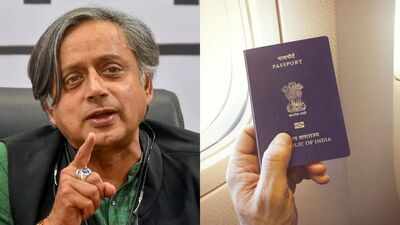
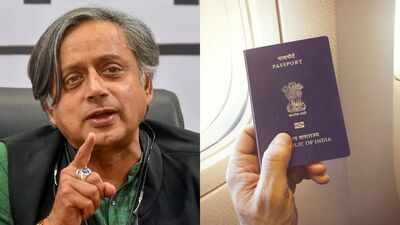
NEW DELHI: Congress MP Shashi Tharoor on Friday called for a legislative overhaul to make passports and Aadhaar cards conclusive proof of Indian citizenship, saying the Centre’s recent clarification that a passport is only a travel document has created an “absurd legal paradox.”In a detailed post on X, Tharoor said the ministry of external affairs’ clarification on Passport Seva Divas had triggered widespread confusion despite the government maintaining that the position has existed since the Passports Act, 1967.“The recent statement by the Ministry of External Affairs (MEA) on #PassportSevaDivas, no less! clarifying that an Indian passport is primarily a ‘travel document and not conclusive proof of citizenship’ has triggered a predictable wave of public bewilderment and political sparring,” he wrote.While acknowledging the government’s legal position, Tharoor argued that it was impractical for ordinary citizens.“While the government defends this as a long-standing legal position rooted in Section 20 of the Passports Act of 1967 (which technically allows the state to issue passports to non-citizens under rare, public-interest circumstances) this is a distinction without a difference, meaningless to the average citizen.”He said the passport has long been regarded as the country’s most credible identity document because applicants undergo extensive police verification and document scrutiny before one is issued.“For decades, the passport has been considered the gold standard of identity. We navigate the gruelling bureaucratic maze of police verifications and document checks required to obtain one, precisely because the state demands concrete proof of citizenship before granting it. To turn around and declare that the very document born from this rigorous vetting does not actually prove citizenship creates an absurd legal paradox. If a passport does not establish domestic citizenship, then what does?”Referring to previous court rulings, Tharoor said Aadhaar has also not been recognised as proof of citizenship.“The Supreme Court has already ruled that the Aadhaar card is merely a proof of identity and residence, not citizenship. This leaves millions of Indians in a bizarre administrative limbo where they possess world-class biometric and state-issued documents, yet none are legally deemed ‘conclusive’ proof of their nationality within their own borders.”To resolve the issue, Tharoor proposed changes to the legal framework.“To end this fatuous controversy once and for all, a common-sense legislative overhaul is urgently required. The government should formally amend the legal framework to make both the passport and the Aadhaar card valid, conclusive proofs of Indian citizenship unless they are explicitly cancelled or withdrawn by the state.”He suggested that the Unique Identification Authority of India (UIDAI) introduce a visually distinct Aadhaar card for non-citizens residing in India, arguing that it would allow the standard Aadhaar card to serve as proof of citizenship.“The solution is straightforward. The Unique Identification Authority of India (UIDAI) should introduce a visually distinct Aadhaar card (featuring, say, a visible diagonal red stripe across the front), specifically designated for non-citizens living in India.”Tharoor added that a dual-document policy, using either a standard Aadhaar card or a valid passport, would simplify identity verification and remove uncertainty over citizenship.The remarks come a day after the MEA reiterated that a passport is primarily a travel document and not conclusive proof of citizenship. The ministry said this has been the legal position since the Passports Act, 1967, which allows passports to be issued to non-citizens in certain exceptional circumstances. Government officials also cited previous court rulings, including a 2013 Bombay High Court judgment, to support the clarification.