

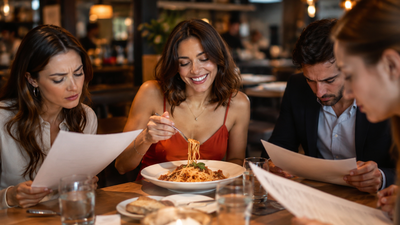
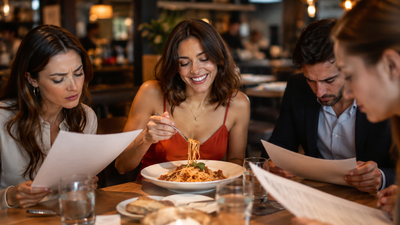
Everyone knows someone who walks into a restaurant, glances at the menu for a few seconds and orders the exact same dish they always do. To some, that habit may seem predictable, but psychologists say it reveals much more than a lack of culinary adventure. Decades of research on food preferences, sensation seeking and eating behaviour suggest that people who repeatedly choose familiar meals may share certain personality traits. Experts including Paul Rozin, Patricia Pliner and Marvin Zuckerman have found that our food choices are shaped by everything from comfort and efficiency to personality and evolutionary instincts.
What psychology says about people who always order the same meal
They value stability and predictability
One of the most studied concepts in food psychology is “food neophobia”, a tendency to avoid unfamiliar foods. Canadian psychologist Patricia Pliner, a professor at the University of Toronto, pioneered much of the research in this area. In a 1992 study published in Appetite, Pliner and Karen Hobden developed the Food Neophobia Scale, which measures people’s willingness to try unfamiliar foods.Their findings showed that some individuals naturally prefer familiar foods and routines. Choosing the same meal repeatedly may therefore reflect a preference for stability rather than a lack of imagination.
They are less driven by novelty
Not everyone enjoys chasing new experiences. Psychologist Marvin Zuckerman, known for his work on sensation-seeking theory, found that people vary in their desire for excitement and novelty.A review chapter by Thomas Alley and Kathleen Potter in the Handbook of Behavior, Food and Nutrition examined how food neophobia relates to sensation seeking. Studies found that individuals with higher sensation-seeking tendencies are more likely to experiment with unfamiliar foods, while those with lower scores often prefer tried-and-tested options.
They tend to be more cautious
Patricia Pliner’s 1997 study, conducted with Nancy Melo and published in Physiology & Behavior, found that high sensation seekers were more willing to sample novel foods than low sensation seekers.Researchers have suggested that reluctance to try unfamiliar foods may have evolutionary roots. Preferring familiar meals could once have protected humans from consuming harmful or poisonous substances. Today, that cautious tendency may simply show up as ordering the same pasta or burger every time.
They like efficiency and fewer decisions
Research on variety-seeking behaviour suggests that not everyone enjoys having endless options. Some people prefer to minimise decision-making and stick with what they already know they enjoy.Psychologist Paul Rozin of the University of Pennsylvania, one of the world’s leading experts on food psychology, has spent decades studying how humans develop likes and dislikes for food. His work, including the paper Towards a Psychology of Food and Eating and later reviews on food preferences, highlights how familiarity plays a major role in shaping eating habits.For many people, ordering the same dish is simply efficient. It saves time and removes the possibility of regret.
They find comfort in familiarity
Food is closely tied to emotions and memories. Studies have shown that familiar foods can provide feelings of comfort and security, especially during stressful periods.Paul Rozin’s work on the psychology of food has repeatedly emphasised that eating is influenced not only by biology but also by culture, emotion and past experiences. A favourite dish may evoke positive memories or simply provide reassurance in an uncertain world.