
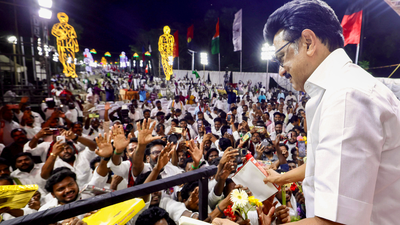
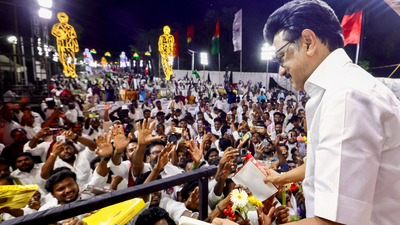
NEW DELHI: The standoff between the Centre and the Tamil Nadu government saw a sharp escalation as chief minister M K Stalin announced a state-wide black flag protest on Thursday, accusing the Union government of pushing a move that could undermine Tamil Nadu’s political weight.Calling the issue a larger battle between southern states and the Centre, Stalin warned that Tamil Nadu would make the Bharatiya Janata Party-led government ‘pay a heavy price’ if its concerns were ignored.After convening an emergency meeting of DMK MPs and district secretaries, Stalin said the proposed delimitation exercise was a “grave danger” and likened it to a looming threat that had now materialised. Calling the Centre’s approach confrontational, Stalin declared that black flags would be raised across Tamil Nadu as a symbol of resistance. He also warned that if the Union government failed to step back, it would face serious political consequences.“This is not about parties, but about protecting the rights of our people,” he said, urging MPs across India to unite in defence of federalism.
What is delimitation?
Delimitation is the process of redrawing the boundaries of electoral constituencies and reallocating Lok Sabha seats among states based on population changes. Under Article 82 of the Constitution, this exercise is meant to follow every Census.At present, the Lok Sabha has 543 elected members, though the Constitution allows up to 550. The Centre now plans to increase this strength to 850 seats — 815 for states and 35 for Union Territories.The current seat distribution is still based on the 1971 Census, as delimitation has been frozen for decades to avoid penalising states that successfully controlled population growth. However, the proposed amendment seeks to lift this freeze and enable a fresh delimitation based on the 2011 Census. The government argues that India’s demographic profile has changed significantly — with migration, urbanisation, and uneven population growth creating disparities in representation.The delimitation exercise is also key to implementing the 33% reservation for women in Parliament and state assemblies under the 2023 law.
Why is Stalin against it?
Stalin has emerged as one of the strongest critics of the Centre’s delimitation push, calling it a bias against South Indian states. Stalin argues that population-based seat redistribution will reduce the political weight of southern states like Tamil Nadu, which have successfully controlled population growth, while boosting representation for northern states with higher population increases.Stalin argues this effectively ‘punishes’ states that performed better on development indicators, turning delimitation into what he calls a ‘historic injustice.’ He has warned that the move could widen the North-South divide and distort India’s federal structure.Tamil Nadu CM also raised fears that the shift could disproportionately tilt power in Parliament toward northern states, weakening the voice of the South in national decision-making.Positioning the issue beyond party politics, Stalin is rallying non-BJP ruled states and calling for a united front, warning of protests and political consequences if the Centre goes ahead without consensus.Stalin has previously warned of large-scale protests that could bring the state to a standstill and invoked the DMK’s history of mass agitations in the 1950s and 60s over state rights.He has also been coordinating with leaders of non-BJP ruled states, including Kerala CM Pinarayi Vijayan and Telangana CM Revanth Reddy, as part of efforts to build a broader coalition against the Centre’s proposal.