

In a first-of-its-kind joint mission, the Chinese and European space agencies are sending the SMILE mission on Tuesday (May 19) to study the Earth’s defences against the Sun. It is set to launch at 05:52 CEST (09:22 IST) on a European Vega-C rocket.
The mission aims to capture the first X-ray images of Earth’s protective magnetic shield in action as it battles and deflects harmful charged particles and energies coming from the Sun.


Smile is ready for launch! 🚀
Follow the final preparations with this video, and join us on 19 May from 05:30 CEST on ESA Web TV for the launch broadcast.
🔗 https://t.co/d00H3O4rjR@esascience @ESA_transport @Avio_Group @CNES @CAS__Science pic.twitter.com/Tb1R5DBg9b
— European Space Agency (@esa) May 15, 2026
These periodic events, when the Sun’s ejections interact with the outer layers of Earth’s magnetic field, give rise to spectacularly bright ‘dancing lights’ in the sky, called auroras. Auroras have been visible from Earth for centuries and evoked a sense of wonder. For the very first time, a satellite placed deep in space will capture the full spectrum of this interaction and take never-before-seen images of a crucial process that enables life on Earth.
By studying these interactions, the SMILE (Solar wind Magnetosphere Ionosphere Link Explorer) mission can help enable an early warning system for solar ejections that would be useful not just in protecting our space assets but also ground-based infrastructure like electricity grids from particularly nasty solar flares.
The shield
The Sun constantly spews various types of matter, magnetic fields, energy and plasma into space. Among the most harmful solar ejections are solar flares, solar storms and coronal mass ejections, all of which are highly potent and can interfere with space weather. Perturbations to space weather can have major ramifications on many of Earth’s critical space assets.
Earth remains largely protected from these ejections, thanks to the magnetic field that blankets it, called the magnetosphere. In our solar system, Earth has one of the strongest magnetospheres. It is a vast, comet-shaped bubble that continuously shields the planet from harmful solar and cosmic particle radiation. It is the magnetosphere that makes it possible for life to form, exist and sustain on Earth. It also acts as a shield, preventing the Earth’s atmosphere from being eroded due to the incoming solar winds. The magnetosphere thus adapts and reacts to the solar, planetary and interstellar conditions, which manifest in space weather from time to time.
SMILE is not the first space mission meant to study the magnetosphere. Past missions like the Swarm and Cluster by the European Space Agency (ESA) have also vastly improved our understanding of this region in space and the processes that happen here.
What sets SMILE apart is that it will, in real-time, be able to capture X-ray images of how the Earth’s magnetosphere instinctively reacts and protects the Earth from numerous incoming solar emissions and charged particles. Unlike previous missions, it will also get a full view of the interactions happening in the magnetosphere.
The mission
Story continues below this ad
SMILE is designed to get answers to what happens when a stream of solar wind interacts with Earth’s magnetic shield and the magnetic glitches occurring on the dark side of Earth. It will help solar physicists better understand space weather.
It will also help heliophysicists forecast any impending solar storm or likely perturbations to space weather. This is vital for the safety of our space-based assets, like satellites and satellite-based communication, GPS, navigation systems and airline operations, as well as uninterrupted operations of space stations and astronaut safety.
The forecasts happen even now, thanks to satellites installed in space for this purpose, but SMILE is expected to significantly improve the accuracy and effectiveness of these forecasts. Unlike our current assets, SMILE is designed to obtain a full view of the interaction and much richer data from them.
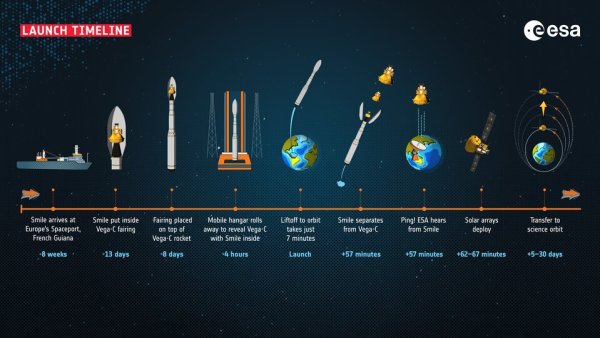 (ESA)
(ESA)
It will be positioned at about 1.21 lakh km above Earth’s north pole and be able to observe the edge of the magnetosphere in its entirety. SMILE weighs about 2,600 kg and has a mission life of about three years. The four onboard instruments will operate both on X-ray and ultraviolet wavelengths of the electromagnetic spectrum. SMILE will provide newer and unique insights into the magnetosphere’s behaviour and interactions with solar storms.
Story continues below this ad
The mission is carrying four scientific instruments, weighing 70 kg in total. All these payloads will use remote sensing and make in situ (on site) observations along the near-Earth regions.
ESA has developed the Soft X-ray Imager (SXI), whereas the Chinese team has developed the other three payloads — Magnetometer, Light Ion Analyser (LIA) and Ultraviolet aurora Imager (UVI).
European countries Austria, Belgium, Denmark, France, Germany, Italy, Luxembourg, the Netherlands, Norway, Spain, Switzerland and the UK have worked with the Chinese on this mission. While the Chinese and European space agencies have worked together in the past, this is the first time that they are sending a joint mission to space.