

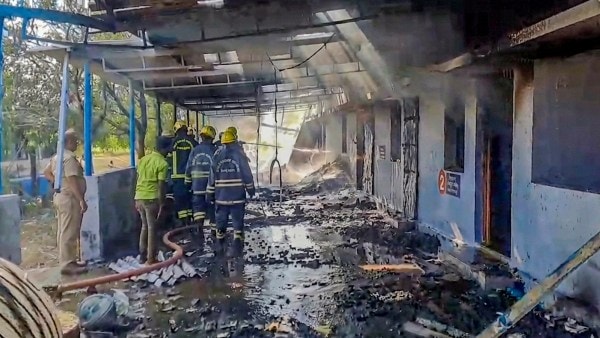
Over the course of three days this week, southern India saw two separate firecracker accidents that killed dozens of people.
On Tuesday (April 21), at least 14 people were killed in Kerala’s Thrissur district after two explosions, seconds apart, ripped through a firework assembly unit. The incident, which came days ahead of the Thrissur Pooram festival, prompted the state government to scrap the annual event’s famed fireworks display.
And on Sunday (April 19), a massive explosion at a fireworks factory in Tamil Nadu’s Virudhunagar district left at least 23 people dead. Virudhunagar manufactures 90% of the fireworks in India.
The cause of the explosions is unclear. The Kerala government Wednesday ordered a judicial probe into the Thrissur incident. In the Virudhunagar incident, investigators are expected to examine potential safety lapses or mishandling of combustible chemicals.
India regularly sees explosions in firecracker factories. In the firework manufacturing hub of Virudhunagar, for instance, over a hundred people reportedly died in firecracker unit accidents between 2022 and mid-2025.
While part of the reason for such accidents lies in the chemical raw materials themselves, climate, safety violations and lack of enforcement also play a key part. Here’s a look at the issue.
First, how does a firework function?
Scientifically, there are four components in a firecracker: An oxidiser, fuel, ‘stars’ and a binder.
Story continues below this ad
Burning requires oxygen. The oxidisers in fireworks are chemicals that release oxygen to allow the explosion to take place. The most commonly used oxidisers are nitrates, chlorates and perchlorates.
Burning also requires fuel. The core explosive is generally black powder, a mixture comprising 10% sulfur, 15% charcoal, and 75% potassium nitrate.
The oxidiser breaks down the chemical bonds of the fuel, releasing energy and heat — in other words, causing the explosion.
The ‘stars’ are solid chemical lumps that are responsible for creating the bright colours and light we usually associate with a firework. Aluminium compounds produce brilliant whites, barium nitrate produces greens and the addition of copper results in blue light.
Story continues below this ad
Binders are used to hold the mixture of the firecracker together in a paste. Binders don’t actually begin to work until the firework has been lit.
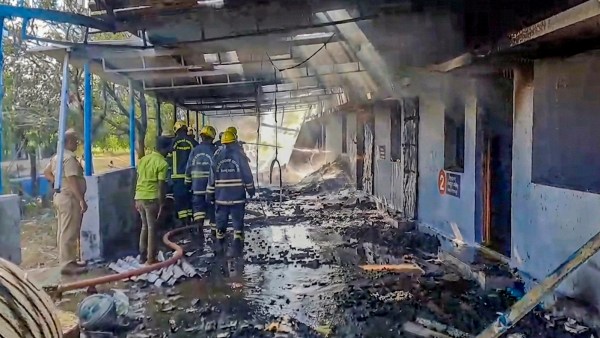 Firefighters at the site of the Virudhunagar blast. PTI
The ignition mechanic is an age-old process. Take the case of an aerial firework.
When the fuse or wick is lit, heat travels through the shell — the main part of the firework — which is housed inside a mortar (essentially a steel tube).
The spark then reaches the “lift charge” — the black powder mentioned above. The ignition of this powder displaces enough gas to propel the shell out of the tube and into the atmosphere.
Story continues below this ad
Upon reaching a certain height, a timed second fuse ignites, activating the “burst charge”. This burst charge is responsible for setting off the chemical ‘stars’ housed in the shell.
The ‘stars’ are densely packed with heavy metals such as barium, strontium and copper. When these compounds combust or are mishandled during assembly, they aerosolise into toxic, microscopic pollutants.
The entire process is essentially a reaction involving powerful chemicals. This makes the process of manufacturing, handling and storing fireworks inherently risky.
How does climate affect firecracker safety?
The deeply chemical nature of firework production ensures that factors such as the climate, particularly extreme weather, drastically affects manufacturing.
Story continues below this ad
Warm, dry weather is more suitable for manufacturing fireworks than excess moisture conditions.
But the summer heat also provides the conditions that can increase the risk of an explosion.
The primary scientific risk attached to handling such volatile chemicals in large quantities together is the accumulation of static energy.
Low-humidity environments prevent the safe dissipation of static charges in the air, which is exacerbated in the summer. As a result, basic movements on the factory floor — such as mixing dry chemical powders or sliding materials across a workbench — can generate an invisible static spark capable of igniting ambient chemical dust.
Story continues below this ad
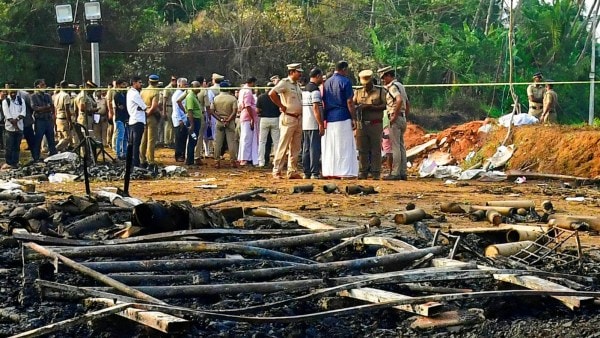 The site of the explosion in Thrissur. PTI
While Virudhunagar is not a particularly low-humidity area, it still sees several firecracker unit accidents. This is because it is located in a hot, arid area which sees little rainfall because of the Western Ghats barrier.
However, it’s not just dry weather that poses a danger.
The variability of high, dry heatwaves in the day with heightened humidity in the mornings and evenings may introduce moisture into the facilities. If moisture interacts with certain poorly stored chemical compounds, it can trigger an exothermic reaction.
In standard, safe procedures, chemical slurries mixed with water must be dried carefully under shadow platform sheds to avoid dangerous heat accumulation. However, if dampness seeps into volatile chemical piles, which are subsequently baked dry by the intense summer sun, the chemicals become highly unstable and can spontaneously combust.
Story continues below this ad
Ultimately, it is this violent fluctuation of atmospheric temperature, pressure and humidity that serves as the root cause of explosions during chemical mixing and drying.
Even without an explosion, stagnant summer heat effectively traps the toxic chemical dust generated during the mixing process close to the ground, drastically increasing the oxidative potential of the air inside and immediately surrounding the facilities.
The human factor in handling fireworks
The dangers of static energy and shifting climates however, are not unheard to either the scientific community or firework factory owners. While the laws of science may provide the initial spark, non-scientific human factors are the key reason these sparks turn into infernos.
The explosion risk on the factory floor is heavily compounded by a precarious labor system where workers are paid by the pieces produced, driven by high market demand. This piece-rate system inherently incentivises speed over strict safety protocols.
Story continues below this ad
Systemic regulatory failures further exacerbate the danger. While guidelines exist, there are significant limitations in the enforcement of the Explosives Act, 2008. Non-compliance is rampant, particularly regarding the vital importance of proper storage.
Over the past decade, numerous explosions have escalated into mass-casualty events because factory operators routinely stockpile raw, volatile materials and finished fireworks in cramped, unventilated spaces far beyond the legally permissible limits.
So when a static spark does occur in the summer heat, these unregulated stockpiles ensure a minor flash becomes a deadly chain reaction.